Showing posts with label Trikafta. Show all posts

Thursday, January 26, 2023

An Ode to My Feeding Tube


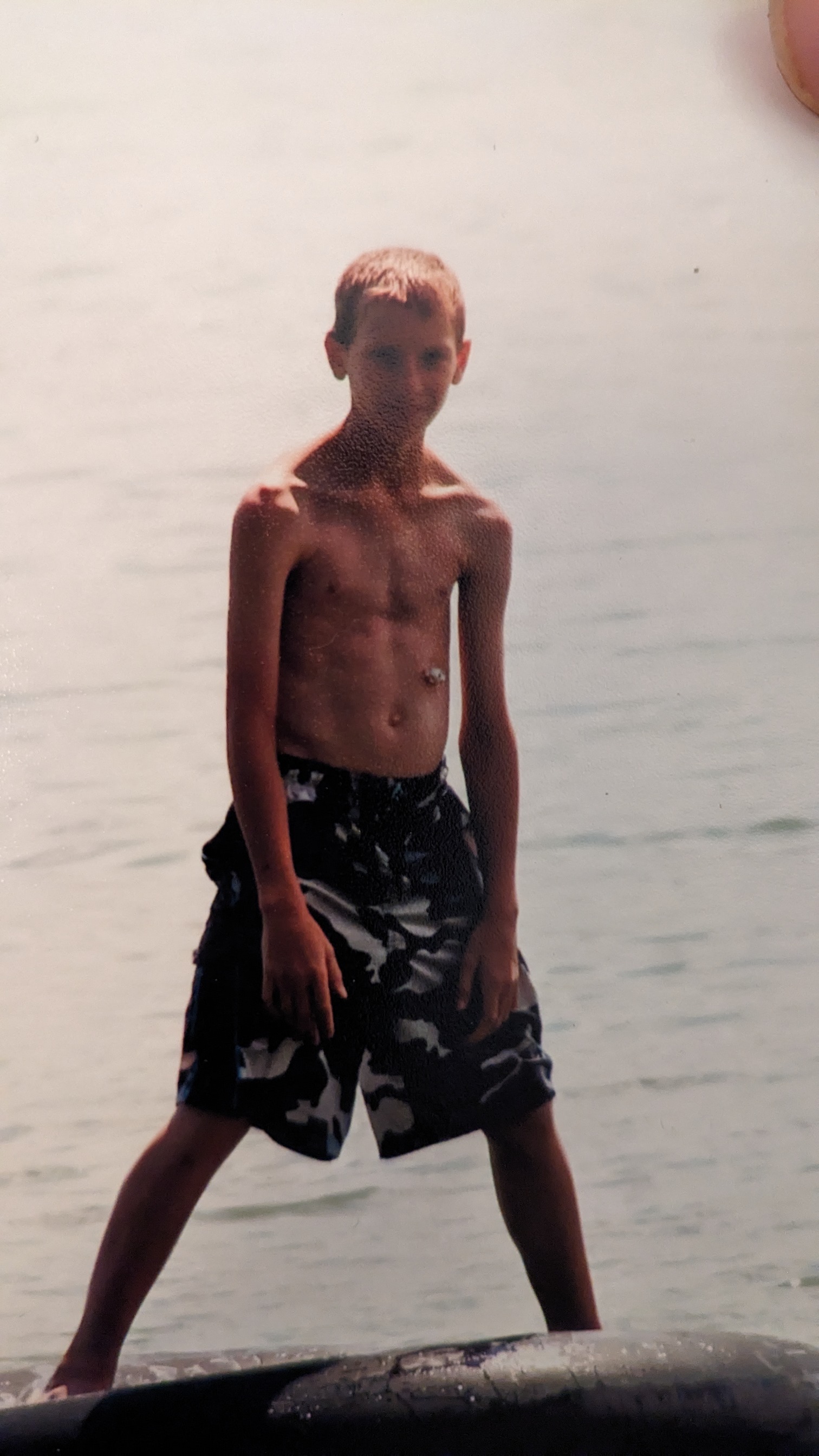
One of the last pictures I could find before I got my feeding tube, circa 2004

About 18 years ago, I was in first grade. I was pretty much like any first grader; I enjoyed learning, my favorite sport was baseball, I spent a lot of time outside playing games and using my imagination. I liked superheroes, I had a lot of friends, I was curious. And I had a feeding tube. 


One of the first pictures I have of me with my tube, circa 2005

Getting my feeding tube was one of the first surgeries I ever had. If I’m being honest, I can’t really recall the emotions I felt as a first grader who learned they had to get a tube placed in their stomach. I wish I could say for certain that I was nervous or scared, but honestly, I don’t know if I even really knew what it was or what it meant. I suppose, in a way, I was fortunate not to realize that. Ignorance, in this case, was bliss. If the doctors or my parents would have told me that for the next 18 years of my life, I’d have this… thing sticking out of my stomach, I probably would have been pretty adverse to it. 

Like most kids who need surgery in first grade, sure I was probably scared and nervous. But I had a wonderful support system and I got the tube placed. In fact, I actually got to show it off for show and tell later in the year! (Thanks, Mrs. Birch, for humoring 7-year-old me.)


Now, at 25, it is hard to remember life without a feeding tube. 18 years is a long time, especially when that clock starts when you’re just 7 years old. I was too young to realize the magnitude of the surgery. Before that milestone in my life, I hadn’t really “needed” a flat stomach, if that makes sense. Except for the occasional slip and slide, I wasn’t diving headfirst into anything, I wasn’t thinking about what kind of contact sports I might want to play. I didn’t go off diving boards or ride waves in the ocean with a boogie board. I didn’t slide across ice or snow like a penguin. Because I was young. Those things hardly even crossed my mind, ever. 


But now, those things can cross my mind without being immediately dismissed. Not that I have a lot of opportunities to go on slip and slides, or dive headfirst into a base or off a diving board, or play contact sports or anything like that. But that’s not the point; the point is that now, I can do those things. 


Because after 18 years of having a feeding tube, I was recently able to remove it, for good. 


The last picture of me with my feeding tube!

My feeding tube has simply served its purpose. When it was placed 18 years ago, I was severely underweight, just as many CFers are. It enabled me to receive extra nutrition and calories when I slept overnight. I’d hook up my feeding tube to a machine that essentially fed me throughout the night, pumping me with something like an additional 1,000 - 2,000 calories while I slept. I didn’t have visions of sugar plums - I had visions of turkey feasts. 


The last time I remember using my feeding tube was right around April 2020, nearly three years ago. I actually think I might have used it once or twice between August and September of 2020, but even so, it's been a while. And, in fact, before April 2020, I rarely used my feeding tube. In college, my use was so sporadic, I’m sure it did help, but not to the extent it could have. 


Once again, thanks to a combination of my own motivation and dedication to my health, along with the miracle drug Trikafta, I have been able to shed more burdens and aspects of CF that have been so extremely foundational and instrumental in my life, for as long as I can remember. 


It is so strange to have this part of me now removed. I am flooded with emotions: excitement, relief, freedom, grief. I don’t remember life without a feeding tube. I have grown so accustomed to having it in. My body naturally protects my stomach when I am in crowds or close to bumping into a wall. My hands reach for the area after I jump in the water or take off a sweater. I can already feel the “phantom limb” taking effect; my mind and body expect the tube to be there, and I still am surprised when it’s not. 


After 18 years, my feeding tube has finally been removed for good.


Right now, I’m keeping some gauze over the site. When I took it out, there was no procedure, no stitching; my doctor said it should heal on its own and close up. So really, there’s just been a hole in my stomach for the last week, which has been kind of freaky. After I eat a meal, the site will sometimes leak a bit, but even that has reduced significantly. What’s going to be really weird is when I can take off the gauze and just have a plain, flat stomach. 


Other CFers have reported having their site heal up but leaving a deep scar — they’ve described it as basically having a second belly button. So the staring might not stop, but after 18 years, I’m used to it. What I do need to get used to is the freedom I’ll have. This summer, I definitely want to go on what I can only imagine is one of my first head-first dives into a slip and slide. I want to play baseball and steal second, sliding into the base with my arms outstretched. I want to play frisbee and layout for the disc. Maybe I’ll even try my hand at tackle football (probably not, but it won’t be because of my feeding tube!). 


My feeding tube and I have been through some stuff. There are at least 4 separate occasions that I can recall it falling out suddenly and me needing to quickly get it replaced, including once in the ocean and once at the local pool. Life is always exciting.


It’s going to take me some time to get used to this new body, for sure. My feeding tube has become such a familiar site and feeling for me. I am shedding a part of my life that I literally do not remember not having. But this is going to open up more opportunities for me, as well. And, just like everything else, it signifies the progress we are making toward a cure for CF. 


Saturday, April 16, 2022

My new attachment: update!

 After seven years of having my port, I finally got it removed in April. My port was used mostly for IV antibiotics (or the odd miscellaneous infusions), but having not used it for 3+ years, my doctor determined that it had finally become obsolete. 

In fact, the last time I needed any antibiotics was in 2019. That was also the last year I went into the hospital, and in November of 2019, I started Trikafta, which has drastically changed my life. 

The day I got my port, August 2014
I don't think Trikafta is the only factor behind getting my port out, though. One major benefit, ironically, has been COVID. Masking and social distancing - surprise, surprise - has greatly helped keep me safe and healthy, not only from COVID but from all sorts of other infections. I've barely had colds in the last few years, let alone major illnesses. But I've also been more diligent and proactive in my health by myself. I've taken on the responsibilities of CF with everything I've got. I remember in 2019 I made it a personal goal to only go in the hospital once that year. Little did I know that'd be the last time I'd go in indefinitely. It hasn't been Trikafta doing all the work (though I admit it has done a lot of the heavy lifting). I've stepped up hard to make it happen. And I'm proud of the progress I've made.


It is a weird feeling having my port out. It was overwhelming getting it out. When I got it placed, it was just a few short months after Anna had died. I had told her about needing to get one. My port has gone through its entire lifespan since she died. 

Jeph standing by the door after his surgery, with no port in his abdomen.
Post-portum 

Jeph standing by the door pre-surgery, his port showing prominently in his abdomen.
Before. Look how fat I am compared to 2014!


But it's also an amazing feeling to have it out. Sure, it doesn't necessarily feel much different, but the implications and general sense of having it out is incredible. My doctor and I have begun discussions to remove my feeding tube. I haven't used that in more than a year now, and I've gained between 6 - 10 pounds on my own in that time (in fact, my doctor used the word "moderation" with me for the first time ever!). While this step will take a bit more discussion and planning, it is amazing to be having the discussion in the first place. 

My port coming out isn't without its challenges, either. Of course, we don't know what Trikafta has in store for CF patients long-term. Theoretically, it should work forever and then some. But it doesn't mean I don't have CF. Needing antibiotics is still a very real possibility, and now that I don't have a port, my options are oral antibiotics or getting an IV or PICC. Hopefully oral antibiotics would do the trick, because my body was beginning to get used up in terms of getting PICC lines placed. It isn't impossible, and I can still technically get another port placed in the absolute worst-case scenario. But hopefully we don't even have to cross that bridge because we won't come to it. 

My CF updates seem to be happier and more hopeful every time, but with them I always need to remind myself that cystic fibrosis is a progressive disease and we simply don't have the data for how Trikafta affects patients long-term, or what "long-term" even means. I still have CF, and many patients around the world do and they don't necessarily have the ability to take Trikafta. With every celebration comes an important reminder and consideration that while it is good and important to hope and plan and look forward, it is even more important to stay present and know what is here for us today. For me today, that means enjoying not having a port anymore!


Wednesday, April 21, 2021

Imposter Syndrome

Imposter syndrome (n): "A psychological condition that is characterized by persistent doubt concerning one's abilities or accomplishments accompanied by the fear of being exposed as a fraud despite evidence of one's ongoing success" (Merriam-Webster). 

Imposter syndrome is a common phenomenon, especially in the world of academia. Many people feel like they don't belong in the group - whether that is academic, athletic, or otherwise - because they don't always know what they're doing, or their success looks different than others, or at least it is perceived to be different. But what does having CF "successfully" look like? What does that mean? Coughing a bunch? Producing mucus when you cough, needing to take breaks while exercising more than your peers? Scheduling your entire life around doing treatments, waking up extra early to do them, or staying in the hospital, being on IV antibiotics, knowing your nurse's work schedule? Because if so... 

After being on Trikafta for 16 months, and having not been in the hospital for over two years(!!), and needing minimal antibiotic treatments (no IV antibiotics in 2 years), I feel... almost like I don't have cystic fibrosis anymore. Now, I say this to illustrate a point only. Obviously I still have CF; I have to go to doctor appointments, I still do two treatments a day, my weight gain still needs support from my feeding tube, and I still have to take medicines like enzymes, insulin, and of course, Trikafta. And it's this last one, Trikafta, that has changed everything about my life, from my energy levels to my lung functions to my mental state. After 22 years of living in a certain way, a way that constricted and forced and deprived and choked me, I feel like I can really breathe. 

Which makes me feel like an imposter in the best way possible. 

In the past two years, my energy levels have been higher than I knew possible (and I've just naturally been a highly energetic person). I'm always itching to go do something (COVID has been tough!. I feel like I'm dancing and singing around the house no matter what I'm doing, I've gone on 10+ mile bike rides, I can play racquetball without needing many breaks, and life has been (has always been, but is perhaps more so) amazing. Before taking Trikafta, I was able to do these things, but to a much lesser extent. I couldn't imagine going on a bike ride for more than maybe 1/2 hour. Racquetball hurt my lungs. I loved laughing but that much force coming from my body often caused me to cough. And when I coughed, always mucus. And usually thick, green mucus (green indicating infections/illnesses). Now? I honestly, really truly, cannot remember the last time I coughed up mucus. Maybe a few months ago? Maybe? I love not remembering that. On the rare occassions when I do produce anything, it's white and thin, more closely resembling spit than phlegm. 

The numerical data backs up my energy levels, as well. My PFTs have increased 30% since starting the medicine. They haven't been that high since 2014!! These numbers are incredible, and they only keep rising. And the changes in my everyday life is proof of how this medicine is making me feel "normal." Before Trikafta, I never missed a single treatment. I did three treatments every single day, without fail. Now I am able to do two treatments a day and sometimes, around once a month, I allow myself to miss a treatment (though I usually still do a quick nebulizer) if I've had a late night or something. That worried me at first, and I was cautious when skipping treatments, but this is exactly what Trikafta was for. To make my life easier. To make my life better. And it gets better each and every day, in all aspects.

A graph of my PFTs (lung function tests) from 2005 (left) to 2021 (right).
See the recent upward trend!


My mental state has changed in the past two years, as well. My life for the last 22 years has been consumed with cystic fibrosis. It was the only thing on my mind, and I made CF my life (or really, CF made itself my life!). I didn't have a choice but to focus on my health, how it would affect my future, my college experience, my married life, my work life, my social life, my activities, everything. In fact, before Trikafta - and before the pandemic - I was really nervous about entering the workforce, but the combination of Trikafta and COVID-19 forcing people to work from home, I've been able to reclaim even the mundane aspects of "normal" living, including the 9-5. I even started saving for retirement. That is something that has surprised me completely; so many times I've had the explicit (and rather freeing) thought of not having to worry about money in the future, because more likely than not that future wouldn't come. It's an incredible feeling being allowed to dream of taking out of my 401k. 

But I am guilty, too. Because CF isn't the only thing on my mind anymore, because it isn't my life, because I don't need to worry about if I'm going into the hospital or how I can squeeze in all my treatments today, or coughing excessively at work, I'm not talking about it as much. My disease isn't as serious anymore. I don't advocate like I used to, I don't blog as much, I don't seek out advice or videos or blogs from fellow CF-ers. I'm not as involved in the community and while it feels nice to be able to take a break from it, I feel bad. Because CF is still a very real disease. It is still serious. Not everyone in the CF population can take Trikafta. There are those who are still hurting, whose lives are still centered around taking that next breath. And it's those who I (and others!) need to advocate and pray for and support. And, more likely than not, I will still die prematurely, even though it may (God willing) be later than 40 like I've imagined my entire life. I can't forget that. I wouldn't say I'm letting my guard down necessarily, but I'm letting myself forget about CF. And that's what's so bittersweet about all this.

I don't want to get my hopes up. I don't want my loved ones to be so encouraged and then have to say goodbye before I retire. While Trikafta is a miracle, and one I am grateful for every time I eat a scoop of peanut butter in the morning, I can't forget why I'm taking it. Because I have cystic fibrosis. I do, and I am not an imposter. I may not be coughing as much, I am able to loosen the rigidity of my treatments, I don't seek out every opportunity to talk about the disease or advocate or post something new, and I am allowed to breathe and live. But the disease is still very real and I cannot forget that.

It has been a cheesy saying since the dawn of time that I still have CF, but I can finally, really truly say now, that CF does not have me.