Thursday, January 26, 2023

An Ode to My Feeding Tube


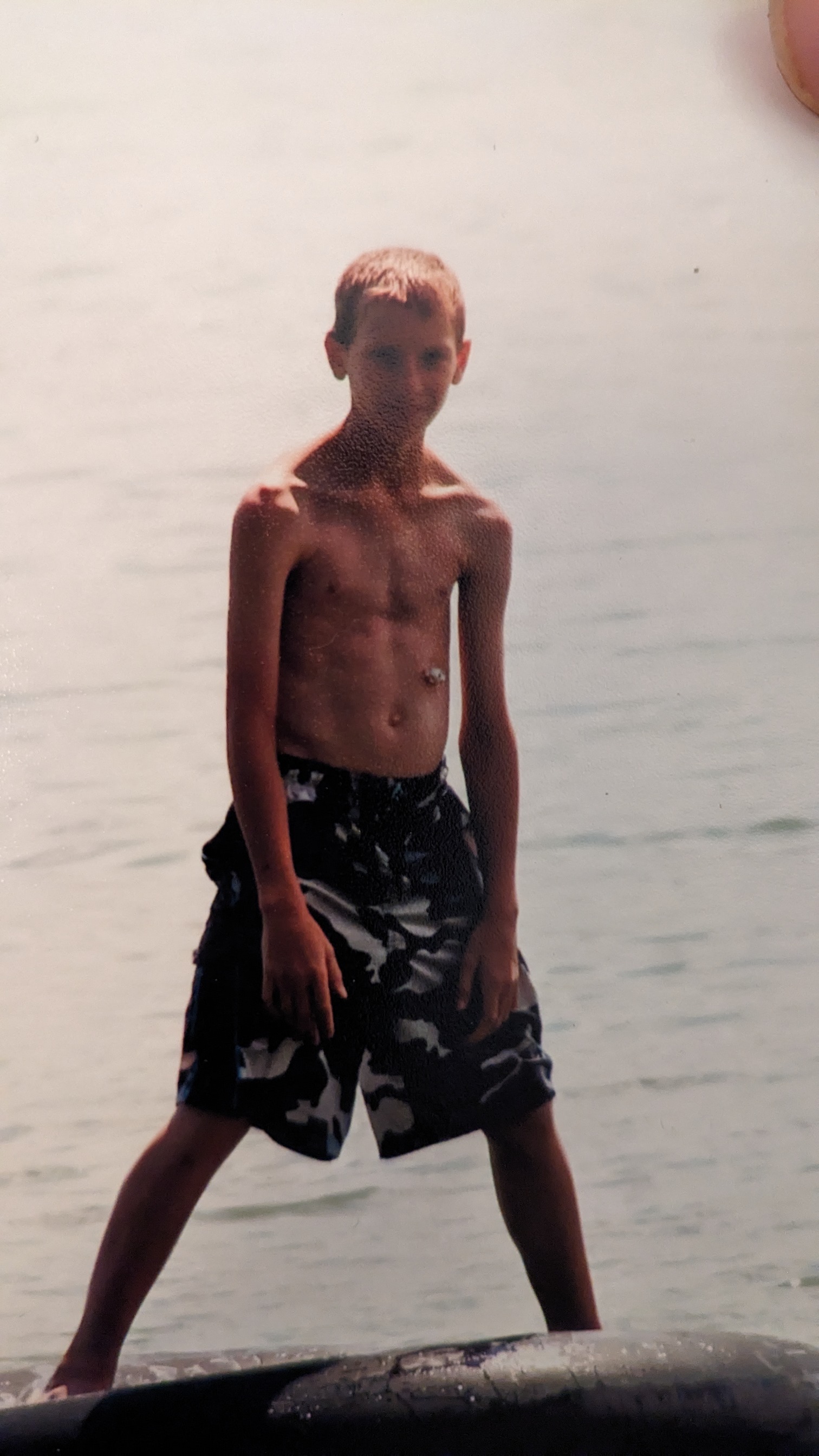
One of the last pictures I could find before I got my feeding tube, circa 2004

About 18 years ago, I was in first grade. I was pretty much like any first grader; I enjoyed learning, my favorite sport was baseball, I spent a lot of time outside playing games and using my imagination. I liked superheroes, I had a lot of friends, I was curious. And I had a feeding tube. 


One of the first pictures I have of me with my tube, circa 2005

Getting my feeding tube was one of the first surgeries I ever had. If I’m being honest, I can’t really recall the emotions I felt as a first grader who learned they had to get a tube placed in their stomach. I wish I could say for certain that I was nervous or scared, but honestly, I don’t know if I even really knew what it was or what it meant. I suppose, in a way, I was fortunate not to realize that. Ignorance, in this case, was bliss. If the doctors or my parents would have told me that for the next 18 years of my life, I’d have this… thing sticking out of my stomach, I probably would have been pretty adverse to it. 

Like most kids who need surgery in first grade, sure I was probably scared and nervous. But I had a wonderful support system and I got the tube placed. In fact, I actually got to show it off for show and tell later in the year! (Thanks, Mrs. Birch, for humoring 7-year-old me.)


Now, at 25, it is hard to remember life without a feeding tube. 18 years is a long time, especially when that clock starts when you’re just 7 years old. I was too young to realize the magnitude of the surgery. Before that milestone in my life, I hadn’t really “needed” a flat stomach, if that makes sense. Except for the occasional slip and slide, I wasn’t diving headfirst into anything, I wasn’t thinking about what kind of contact sports I might want to play. I didn’t go off diving boards or ride waves in the ocean with a boogie board. I didn’t slide across ice or snow like a penguin. Because I was young. Those things hardly even crossed my mind, ever. 


But now, those things can cross my mind without being immediately dismissed. Not that I have a lot of opportunities to go on slip and slides, or dive headfirst into a base or off a diving board, or play contact sports or anything like that. But that’s not the point; the point is that now, I can do those things. 


Because after 18 years of having a feeding tube, I was recently able to remove it, for good. 


The last picture of me with my feeding tube!

My feeding tube has simply served its purpose. When it was placed 18 years ago, I was severely underweight, just as many CFers are. It enabled me to receive extra nutrition and calories when I slept overnight. I’d hook up my feeding tube to a machine that essentially fed me throughout the night, pumping me with something like an additional 1,000 - 2,000 calories while I slept. I didn’t have visions of sugar plums - I had visions of turkey feasts. 


The last time I remember using my feeding tube was right around April 2020, nearly three years ago. I actually think I might have used it once or twice between August and September of 2020, but even so, it's been a while. And, in fact, before April 2020, I rarely used my feeding tube. In college, my use was so sporadic, I’m sure it did help, but not to the extent it could have. 


Once again, thanks to a combination of my own motivation and dedication to my health, along with the miracle drug Trikafta, I have been able to shed more burdens and aspects of CF that have been so extremely foundational and instrumental in my life, for as long as I can remember. 


It is so strange to have this part of me now removed. I am flooded with emotions: excitement, relief, freedom, grief. I don’t remember life without a feeding tube. I have grown so accustomed to having it in. My body naturally protects my stomach when I am in crowds or close to bumping into a wall. My hands reach for the area after I jump in the water or take off a sweater. I can already feel the “phantom limb” taking effect; my mind and body expect the tube to be there, and I still am surprised when it’s not. 


After 18 years, my feeding tube has finally been removed for good.


Right now, I’m keeping some gauze over the site. When I took it out, there was no procedure, no stitching; my doctor said it should heal on its own and close up. So really, there’s just been a hole in my stomach for the last week, which has been kind of freaky. After I eat a meal, the site will sometimes leak a bit, but even that has reduced significantly. What’s going to be really weird is when I can take off the gauze and just have a plain, flat stomach. 


Other CFers have reported having their site heal up but leaving a deep scar — they’ve described it as basically having a second belly button. So the staring might not stop, but after 18 years, I’m used to it. What I do need to get used to is the freedom I’ll have. This summer, I definitely want to go on what I can only imagine is one of my first head-first dives into a slip and slide. I want to play baseball and steal second, sliding into the base with my arms outstretched. I want to play frisbee and layout for the disc. Maybe I’ll even try my hand at tackle football (probably not, but it won’t be because of my feeding tube!). 


My feeding tube and I have been through some stuff. There are at least 4 separate occasions that I can recall it falling out suddenly and me needing to quickly get it replaced, including once in the ocean and once at the local pool. Life is always exciting.


It’s going to take me some time to get used to this new body, for sure. My feeding tube has become such a familiar site and feeling for me. I am shedding a part of my life that I literally do not remember not having. But this is going to open up more opportunities for me, as well. And, just like everything else, it signifies the progress we are making toward a cure for CF. 


Saturday, April 16, 2022

My new attachment: update!

 After seven years of having my port, I finally got it removed in April. My port was used mostly for IV antibiotics (or the odd miscellaneous infusions), but having not used it for 3+ years, my doctor determined that it had finally become obsolete. 

In fact, the last time I needed any antibiotics was in 2019. That was also the last year I went into the hospital, and in November of 2019, I started Trikafta, which has drastically changed my life. 

The day I got my port, August 2014
I don't think Trikafta is the only factor behind getting my port out, though. One major benefit, ironically, has been COVID. Masking and social distancing - surprise, surprise - has greatly helped keep me safe and healthy, not only from COVID but from all sorts of other infections. I've barely had colds in the last few years, let alone major illnesses. But I've also been more diligent and proactive in my health by myself. I've taken on the responsibilities of CF with everything I've got. I remember in 2019 I made it a personal goal to only go in the hospital once that year. Little did I know that'd be the last time I'd go in indefinitely. It hasn't been Trikafta doing all the work (though I admit it has done a lot of the heavy lifting). I've stepped up hard to make it happen. And I'm proud of the progress I've made.


It is a weird feeling having my port out. It was overwhelming getting it out. When I got it placed, it was just a few short months after Anna had died. I had told her about needing to get one. My port has gone through its entire lifespan since she died. 

Jeph standing by the door after his surgery, with no port in his abdomen.
Post-portum 

Jeph standing by the door pre-surgery, his port showing prominently in his abdomen.
Before. Look how fat I am compared to 2014!


But it's also an amazing feeling to have it out. Sure, it doesn't necessarily feel much different, but the implications and general sense of having it out is incredible. My doctor and I have begun discussions to remove my feeding tube. I haven't used that in more than a year now, and I've gained between 6 - 10 pounds on my own in that time (in fact, my doctor used the word "moderation" with me for the first time ever!). While this step will take a bit more discussion and planning, it is amazing to be having the discussion in the first place. 

My port coming out isn't without its challenges, either. Of course, we don't know what Trikafta has in store for CF patients long-term. Theoretically, it should work forever and then some. But it doesn't mean I don't have CF. Needing antibiotics is still a very real possibility, and now that I don't have a port, my options are oral antibiotics or getting an IV or PICC. Hopefully oral antibiotics would do the trick, because my body was beginning to get used up in terms of getting PICC lines placed. It isn't impossible, and I can still technically get another port placed in the absolute worst-case scenario. But hopefully we don't even have to cross that bridge because we won't come to it. 

My CF updates seem to be happier and more hopeful every time, but with them I always need to remind myself that cystic fibrosis is a progressive disease and we simply don't have the data for how Trikafta affects patients long-term, or what "long-term" even means. I still have CF, and many patients around the world do and they don't necessarily have the ability to take Trikafta. With every celebration comes an important reminder and consideration that while it is good and important to hope and plan and look forward, it is even more important to stay present and know what is here for us today. For me today, that means enjoying not having a port anymore!


Saturday, July 10, 2021

July 10, 2021

Anna died when she was 8,667 days old. As of July 10, 2021, I am older than my older sister. And while I wouldn't say I have survivor's guilt, it isn't fair that I am "older" than her, that I am living longer than she did.
I suppose it shouldn't mean anything that I am 8,668 days old and Anna only got to see 8,667 days. The average US life expectancy based on a quick Google search is right around 78 years, which is close to 28,400 days. Anna, in a sense, got 20,000 days of her life taken away from her. 

And yet, she didn't. Every day for Anna was an infinitude and every tomorrow was a dream. God gave her each day and Anna thanked Him with laughter and joy and sometimes anger and impatience and a whole personality words cannot describe. But Anna took each day as her own, and every day no matter what she put out, she rarely put out the fight she was fighting, and she fought that fight hard. 

I know, because I'm fighting it too. I'm just fighting it longer, and recently my fight has gotten easier. So, maybe in a sense, I do have survivor's guilt. I often think I'm not using my life the way I should be. I know we romanticize people when they die, but looking back I think Anna had a life to be proud of, and she did that in fewer days than I did. 

In a way, this odd celebration of life I am experiencing today feels like a midlife crisis, a crisis that is pushing me to be better, holier, happier, more loving and more care-free. I still look up to my late sister - she is still older than me, and the way I remember her makes her feel much older and wiser. I feel too young, too inexperienced to be 8,668 days old when I compare myself to Anna. I don't feel like I've done enough. 

 And that's the crazy thing. Anna was so young. I know that now. I keep asking myself, "What if I were dead now?" and that question is heavier than a harmless hypothetical. It is a very real possibility, the evidence being Anna herself. If I were dead now, what would my life be? What would my family say about me? What have I gotten to experience, what do I still want to do? I'm lucky enough to ask these questions. Anna did not really get any warnings. I've said in the past that I would be content with dying once I got married. To marry Noelle, the love of my life, was all I wanted to do. And I still think that is true. While I don't want to die, I would be content with it. But the point is, we don't get to decide that. If I died the day before my wedding day, I wouldn't have been able to negotiate with God. 

Today, I feel as though I am just starting my life. I graduated from college last year, I'm almost a year into my career and my marriage, I have a honeymoon planned, I hope to start a family one day, I hope to take road trips with said family and create holiday traditions and get promoted at work and see every major league baseball stadium, there is a possibility that I want to write a book, and I want to do so much more. 

But is that life? It may be living, but what is life? Because Anna had a life and when we reflect on it, we recognize she didn't get to do most of that stuff. I'm sure she had her own list of things to do, and how much did she cross off? And yet, Anna's life was beautiful. 

So while my life feels like it is just beginning, I recognize that it begun 8,668 days ago. And each day on this earth, whether you have a lung disease or not, is a blessing. And it doesn't matter what you get to do or not do, but how you live and think and pray and treat one another, that creates your life. 

So this, my 8,668th day on this planet, is dedicated to my older sister. She was strong, funny, animated, stubborn, messy, courageous and brave. And she lived.

Wednesday, April 21, 2021

Imposter Syndrome

Imposter syndrome (n): "A psychological condition that is characterized by persistent doubt concerning one's abilities or accomplishments accompanied by the fear of being exposed as a fraud despite evidence of one's ongoing success" (Merriam-Webster). 

Imposter syndrome is a common phenomenon, especially in the world of academia. Many people feel like they don't belong in the group - whether that is academic, athletic, or otherwise - because they don't always know what they're doing, or their success looks different than others, or at least it is perceived to be different. But what does having CF "successfully" look like? What does that mean? Coughing a bunch? Producing mucus when you cough, needing to take breaks while exercising more than your peers? Scheduling your entire life around doing treatments, waking up extra early to do them, or staying in the hospital, being on IV antibiotics, knowing your nurse's work schedule? Because if so... 

After being on Trikafta for 16 months, and having not been in the hospital for over two years(!!), and needing minimal antibiotic treatments (no IV antibiotics in 2 years), I feel... almost like I don't have cystic fibrosis anymore. Now, I say this to illustrate a point only. Obviously I still have CF; I have to go to doctor appointments, I still do two treatments a day, my weight gain still needs support from my feeding tube, and I still have to take medicines like enzymes, insulin, and of course, Trikafta. And it's this last one, Trikafta, that has changed everything about my life, from my energy levels to my lung functions to my mental state. After 22 years of living in a certain way, a way that constricted and forced and deprived and choked me, I feel like I can really breathe. 

Which makes me feel like an imposter in the best way possible. 

In the past two years, my energy levels have been higher than I knew possible (and I've just naturally been a highly energetic person). I'm always itching to go do something (COVID has been tough!. I feel like I'm dancing and singing around the house no matter what I'm doing, I've gone on 10+ mile bike rides, I can play racquetball without needing many breaks, and life has been (has always been, but is perhaps more so) amazing. Before taking Trikafta, I was able to do these things, but to a much lesser extent. I couldn't imagine going on a bike ride for more than maybe 1/2 hour. Racquetball hurt my lungs. I loved laughing but that much force coming from my body often caused me to cough. And when I coughed, always mucus. And usually thick, green mucus (green indicating infections/illnesses). Now? I honestly, really truly, cannot remember the last time I coughed up mucus. Maybe a few months ago? Maybe? I love not remembering that. On the rare occassions when I do produce anything, it's white and thin, more closely resembling spit than phlegm. 

The numerical data backs up my energy levels, as well. My PFTs have increased 30% since starting the medicine. They haven't been that high since 2014!! These numbers are incredible, and they only keep rising. And the changes in my everyday life is proof of how this medicine is making me feel "normal." Before Trikafta, I never missed a single treatment. I did three treatments every single day, without fail. Now I am able to do two treatments a day and sometimes, around once a month, I allow myself to miss a treatment (though I usually still do a quick nebulizer) if I've had a late night or something. That worried me at first, and I was cautious when skipping treatments, but this is exactly what Trikafta was for. To make my life easier. To make my life better. And it gets better each and every day, in all aspects.

A graph of my PFTs (lung function tests) from 2005 (left) to 2021 (right).
See the recent upward trend!


My mental state has changed in the past two years, as well. My life for the last 22 years has been consumed with cystic fibrosis. It was the only thing on my mind, and I made CF my life (or really, CF made itself my life!). I didn't have a choice but to focus on my health, how it would affect my future, my college experience, my married life, my work life, my social life, my activities, everything. In fact, before Trikafta - and before the pandemic - I was really nervous about entering the workforce, but the combination of Trikafta and COVID-19 forcing people to work from home, I've been able to reclaim even the mundane aspects of "normal" living, including the 9-5. I even started saving for retirement. That is something that has surprised me completely; so many times I've had the explicit (and rather freeing) thought of not having to worry about money in the future, because more likely than not that future wouldn't come. It's an incredible feeling being allowed to dream of taking out of my 401k. 

But I am guilty, too. Because CF isn't the only thing on my mind anymore, because it isn't my life, because I don't need to worry about if I'm going into the hospital or how I can squeeze in all my treatments today, or coughing excessively at work, I'm not talking about it as much. My disease isn't as serious anymore. I don't advocate like I used to, I don't blog as much, I don't seek out advice or videos or blogs from fellow CF-ers. I'm not as involved in the community and while it feels nice to be able to take a break from it, I feel bad. Because CF is still a very real disease. It is still serious. Not everyone in the CF population can take Trikafta. There are those who are still hurting, whose lives are still centered around taking that next breath. And it's those who I (and others!) need to advocate and pray for and support. And, more likely than not, I will still die prematurely, even though it may (God willing) be later than 40 like I've imagined my entire life. I can't forget that. I wouldn't say I'm letting my guard down necessarily, but I'm letting myself forget about CF. And that's what's so bittersweet about all this.

I don't want to get my hopes up. I don't want my loved ones to be so encouraged and then have to say goodbye before I retire. While Trikafta is a miracle, and one I am grateful for every time I eat a scoop of peanut butter in the morning, I can't forget why I'm taking it. Because I have cystic fibrosis. I do, and I am not an imposter. I may not be coughing as much, I am able to loosen the rigidity of my treatments, I don't seek out every opportunity to talk about the disease or advocate or post something new, and I am allowed to breathe and live. But the disease is still very real and I cannot forget that.

It has been a cheesy saying since the dawn of time that I still have CF, but I can finally, really truly say now, that CF does not have me.

Saturday, October 24, 2020

We Should Have Been Working From Home A Long Time Ago

 I mean, the title says it all, really. 

Let me detail a timeline of events of my life to put this blog into better context:

1997: I was born with cystic fibrosis.

High school (2012-2016): My CF progressively got worse. That is just the nature of the disease. I was hospitalized numerous times, taking me out of school, forcing me to drop out of high school activities such as school plays and speech, and missing events such as prom and my cousin's confirmation. 

High school through most of college (2012-2019): I needed to wake up an hour earlier than my peers to do a vest treatment with nebulizers, as well as throw up and dry heave, due to the nature of my deteriorating lungs not cooperating with me in the mornings. I'd sit over buckets for 20 minutes every morning, waiting for the coughing and vomiting to stop.

I also had to find at least half an hour in the middle of the day to do another treatment to make sure my lungs stayed clear for the whole day.

Early college (2016-2018): The realization started setting in that I need to find a job that is flexible with my disease, where I can work part time from home, or I'd have to find somewhere where I could have a private room to do treatments, or not work full time, or have some sort of accommodation that would have been very hard to get, especially coming right out of college with nothing to prove I am a competent and skilled worker in my field. 

October 2019: Trikafta was approved. While I knew it was a good drug and was promising, I didn't know exactly what that meant for me.

November 22, 2019: I started Trikafta. In the weeks and months following, I learned what exactly it meant for me. My coughing and mucus production came to a halt. My energy levels soared, I was able to run and exercise more than I had ever before, I could start breathing more deeply than I thought possible, I was able to drop from doing three vest treatments a day to two (with talks of being able to drop down even more in the future), and life got infinitely better, with my CF just a second thought rather than the thing that was constantly on my mind.

2020: COVID-19 hit. People had to work from home. Everyone did! (I mean, almost everyone.) The world adapted to allow people to work from home without even thinking about it.

August 2020: I was able to enter the workforce, working almost 100% from home.


So now for the actual blog.

I lucked out with Trikafta. If that life-changing medicine hadn't been approved, I would have still had to look for a job that was flexible and able to be done from home. I would have been in the "Early college (2016-2018)" dilemma when I graduated college this May. I was worried about working because I coughed all day everyday, and I needed to do a treatment in the middle of the day. I knew that if I worked in an office, my coughing would be distracting for others and embarrassing for myself. I wasn't sure if it would be possible for me to do a treatment in the middle of the day. Not at my desk, certainly, which would've meant having to get a special room in the office for me to step out to do a treatment. And would that mean having to do a treatment over my lunch break?

These were the questions I pondered until I started Trikafta, and really it was once COVID hit that my questions were answered and my worries were relieved.

People who had disabilities without life-saving medicine, people with depression, anxiety, cancers, autism, and so many other disabilities, were still in that work-from-home dilemma, and COVID has really been a blessing in disguise.

It wasn't until COVID struck that the world realized how many people could work from home and do their jobs just as well (people can even start their jobs remotely and still be successful!). The world operated in an ablest way. The world wasn't able to see my perspective, or the perspective of other people with disabilities. (That's what privilege is, by the way. This blog is about having privilege, and it's a real thing. No further questions. Keep reading.)

We should have been working from home a long time ago. Apart from the capitalism aspects of it (which is another conversation for another day), the ableism aspects of working from home, or changing the work week from 5 day 9-5 workweek is something we should have considered not only for those of us with disabilities but for everyone. 

The only thing is, we started working from home when it affected everyone. Rarely were exceptions made before COVID. Working from home for someone with a disability, someone like myself or someone with extreme anxiety, is crucial. I know of people who cannot operate effectively in an office for 40 hours a week due to their mental illnesses. They are competent and smart but in order to work from home they had to prove themselves worthy. I couldn't work from home fresh out of college; I would have had to prove that I was competent enough to do the work before I could take it home. In fact, when I got my job out of school, I had to be in the office three days a week for the first two months while I was training. I still had to prove myself, and as a person with an underlying health condition during a pandemic, that was scary!

Luckily for me, Trikafta allowed me to do that. Others, who didn't receive a life-changing medicine, aren't so lucky. For many, it's work from home or don't work at all. And the world didn't operate like that before COVID, and it still doesn't totally work that way. But it needs to. 

Everyone deserves to work a full-time job if they want. Opportunities shouldn't be limited to someone because they have a disability. We cannot judge people's worth and value and give them fewer opportunities based on their abilities or disabilities. We need to be adaptable. That means helping people get a home office set up, giving them a computer, monitor, mouse, and even an office chair that allows them to be comfortable and able to work. 

My home office setup. Complete with my vest treatment and medicines!

This goes for working parents, too, especially working mothers who need to choose between giving up much-needed recovery and bonding time after having a child and keeping their job. Life isn't all about work, and yet we've made it about that. If you can't work, that's your fault and you need to figure it out. 

I can go on, going into welfare and the "free handouts" people "feel so entitled to" because they're "lazy and unmotivated," but I won't. But please, if you'd like to discuss that, I am always available to talk. 

I hope after the pandemic is over (you know, in five years from now), employers maintain this flexibility and allow people to work from home more than they have already. I hope people can start jobs from home without having to prove they deserve to work from home. If I didn't have Trikafta, I would have been extremely worried about finding a job. The pandemic, though, is what really helped me find a job and work from home while maintaining a lung disease. People with disabilities want to work, the world just has to let them. 

Wednesday, May 13, 2020

The Value of Life: Being Vulnerable During Stay At Home Orders

I don't often use this blog to be political, but I think now is an okay time to talk about a pretty hefty topic. It seems as though the COVID-19 pandemic has illuminated the values people place on life, and whose lives are in fact valuable.

This is a big statement and I'm going to try to articulate my thoughts as best as I can. Please be patient with me as I may circle around some ideas throughout this piece. I also want it to be clear that this is by no means a black and white issue, and at times I am playing Devil's Advocate, because it's very important to consider everything.

The idea of keeping vulnerable persons (people with underlying health conditions such cystic fibrosis---people like myself) and the elderly inside to keep them safe is a good idea. One I fully support. But I've seen a lot of people say how we should allow those who are young and healthy to be out and about, even recreationally. In fact, Governor Tim Walz is flirting with this idea with his Stay Safe Minnesota order. We are blurring the lines between giving people responsibilities and giving people freedom. While I and the rest of the vulnerable population have to stay home because we are at risk, others are starting to be allowed to freely go about their day, even return to work if they so choose.

Now, again, this isn't inherently bad. I want to stay home. I plan on it. I agree that those who are vulnerable need to stay home right now. I support that! But. The language we use must be chosen carefully. The orders should not be allowing non-vulnerable people to resume business as usual. [And yes I'm aware that life is not just continuing as usual, but we are starting to. If not in MN necessarily, then other parts of the US and the world.]
I always like to read the comments and replies people make on news sites' social media posts pertaining to stay at home orders and the pandemic as a whole. The picture below is a good example of this, and I've seen a lot of similar comments on WCCO's and the Star Tribune's coverage of the stay at home order. They show us how people think the vulnerable should stay home while the rest of us can return to our lives. And the revised stay at home orders (or the eliminated stay at home orders, the orders replaced with "Stay Safe" orders) seem to support this idea. If you are vulnerable, you aren't valuable.


Just one of the many comments protesting staying at home


I don't think Walz truly thinks this. I don't doubt that Minnesotans think this, but I like to believe Walz just might not be thinking this through all the way. Why do I have to stay at home while you can do more things? Your freedoms shouldn't require my repression. I'm sorry, but we are not living under a fascist dictator in Governor Walz. Your "rights" to go to the bar or to the salon aren't real when it is at the cost of the community's lives. Think of other people.

If we are starting to resume our normal lives, even if only "healthy" people are starting to resume their lives, then the number of cases will only rise. Then the risk will be even higher for vulnerable people like me. It isn't only up to me to stay home and stay healthy. Everyone needs to. It does not make sense to allow healthy people to go out and risk getting COVID. Because they'll continue to spread it, and it will continue to reach us. And not only us, but everyone. Because everyone is at risk and every one matters (boy I'm really trying to avoid saying all lives matter because yikes).

And COVID is so strange! The majority of COVID-19 patients with cystic fibrosis have reported mild symptoms, there have been very few deaths, and only a handful needed ventilators or ICU care. And there are healthy 30-year-olds who have died from the virus. So why are we saying that the vulnerable groups have to stay indoors while the non-vulnerable people are allowed to start returning to their lives? We cannot measure value of life based on health conditions.

Of course this is only scratching the surface. This conversation goes well into pre-existing conditions in healthcare and universal healthcare and the like. While I agree with the practice, the principles of Stay Safe Minnesota are iffy. Everyone is valuable, everyone is at risk. We can't allow the privileged populations to go out and do stuff that is not deemed necessary while forcing the rest to stay indoors because that's their unfortunate condition. We don't have a choice, but everyone else does.
It is so easy for people to say "If you're scared, don't go out!" when it just is not that simple. I'm sorry that you want a haircut, I'm sorry that you want to see your family, I'm sorry that you want to go to sports games and graduate and have your wedding and go to bars and go to your job and have a normal life. But dammit, so do I. Your freedoms and your longing to return to normalcy are valid, but so are mine.

Thursday, April 23, 2020

Welcome to my life

Well, here we are: wearing masks, staying 6 ft. apart away from people, and worrying about who might be sick and who might get us sick. What a strange world we're living in.

Except... it's not. Not for me, at least.
This blog is not meant to call anyone out, or make people feel guilty. This is a HUGE adjustment for everyone (myself included). But this (or at least a version of this) has been my reality for 22 years now. Every time I go into the hospital, I've had to wear a mask whenever I leave my room. And boy it's uncomfortable, it's embarrassing, it's hard to breathe, and my glasses fog up. Noelle always has to remind me (and sometimes force me) to put my mask on when I go out, because it sucks! I hate wearing a mask. It feels like I'm labelled a sick person and people want to stay away from me. It makes me obviously sick. But it's necessary. And even if I can't infect others with my CF or my sickness during any given hospital stay, I know that it helps prevent me from getting any sicker from others.

I have had to stay 6 ft away from fellow CF-ers, including my friend Natalie. When we were finally able to meet in person after talking online for years, it was really kind of devastating not to be able to hug (or if we were feeling extra formal, even shake hands lol). When I participate in CF events, like the Climb for a Cure or Great Strides, I have to be mindful that there may be other people with CF there, and I am not allowed to get too close to them. Sharing germs can be incredibly dangerous for us, and now we see that it can be just as dangerous for everyone. It's hard always being on alert. You can't really ever let your guard down.

I've never been able to touch things, either. That sounds weird, but with CF I've always been in what's called contact isolation, which means I can't touch things that may have been touched/used by others, especially those who are sick. This meant not being able to go into/use stuff from the craft room in the hospital. Even if it was something that could be disinfected, my parents or visitors had to handle it, and I was not allowed to participate in a lot of things growing up because of that. That increased the feeling of isolation and it sucked.

So trust me when I say, I get it. Welcome to my life. Honestly, it's kind of nice to have the whole world experiencing this feeling. Boy that sounds mean and I'm not saying I'm glad there's a whole pandemic, but it's always easy for people on the outside to tell you to do something, like Noelle making me wear a mask or my parents nagging me to take my medicine, but now that everyone is experiencing what I've had to experience my whole life, I feel validated. People might understand a little bit more.
Honestly, it's sometimes hard to sympathize with people but I recently saw a friend's Facebook post talking about their first experience wearing a mask while working and they talked about how it was hard to breathe and was very uncomfortable and I laughed. I wanted to comment "Welcome to my life! See how hard it is?" but I remembered that this isn't their normal. But this is our shared reality now, and I need to adjust just as everyone else does. It's nice to have people to sympathize with and who appreciate my struggles just as I appreciate theirs.

Recently, my Facebook memories showed me hospital prom 2015, where Noelle and I posed with masks on our face. It's a cute picture! One of my favorites. Now I'm seeing similar pictures with people's weddings (oof. Might have to recreate it for our wedding, too), and again I just kind of smile at the thought of people going through the same thing I've had to go through. I've had proms canceled, a confirmation, and I've put a lot of my life on hold thanks to CF. Life is a struggle, and thanks to COVID-19, we're all struggling. Thanks, COVID-19...

Hospital Prom, 2015. We wore masks before it was cool


I also keep thinking of the movie Five Feet Apart during this time, and at that I do laugh and throw my arms up. People romanticized that struggle, the sickness, the devastation of not being able to be close to your loved ones. One year later, everyone is living that. It isn't so romantic or nice now, is it? It just makes you step back and think about how this really is people's reality. This is my life. I'm glad to have you here.

But of course, I'm not. I want this reality to pass. It's strange, because it won't pass for me ever, really. Yes, I have gotten a lot healthier (ironically). I haven't needed to stay in the hospital or wear a mask or be in situations where I have to stay 6 ft away from people. But then that took over and my experience with that became full time. It was scary when that set in. This pandemic has changed everyone's lives. I just hope that it changes them afterwards, too, and that people can appreciate just a little bit more what living with cystic fibrosis is like.

Sunday, January 19, 2020

Look at me now!

It's been one year and one week since I've been in the hospital. For me, that's huge.
I don't know when the last time I was out of the hospital for more than a year, but it's been a while. In recent memory (since at least freshman year of high school, ~8 years ago), I've gone into the hospital at least once every year, and oftentimes twice a year. Being out of the hospital for more than a year, then, is a really big deal.

The best part? I did it almost all by myself. I didn't have any IV antibiotics, I was on oral antibiotics once, and I was only on Trikafta---the new CF modulator---since November. I've worked for this accomplishment and for maybe the first time ever I successfully fulfilled a New Year's resolution. And I don't plan on stopping.

Trikafta was announced and introduced in November (if my memory and Facebook posts don't fail me). I started the medicine on November 22, 2019, and I have noticed a huge difference. I cough so rarely and when I do it's less productive. If it is productive, my mucus is clear. I haven't seen yellow mucus in two months. That's weird! And, most surprisingly to me, I have more energy than I've ever had. I've been dancing and playing racquetball and on my feet noticeably more. It's such an incredible medicine and I can't ignore its effects. My efforts to stay active and healthy, paired with Trikafta, have paid off. I'm getting healthier. That's something I guess I never thought would happen. You see, cystic fibrosis is a chronic, progressive disease, which means that it gets worse over time. The older you get, the less healthy your lungs get. Trikafta has flipped that switch. (Not completely. I want to be clear that I do still have CF and I have to take all my medicines and do all my treatments still. The progression has slowed significantly and technically has reversed ever so slightly in terms of my lung functions, but the disease itself is still there and needs to be treated and will still get worse over time. That time, however, will be longer than before.)

I'm graduating college in May. I'm getting married in June. My life is just beginning and this medicine has come into my life to support my plans. My goal to stay out of the hospital for a year was inspired by my graduation and marriage and job plans; I didn't know of Trikafta until it was announced in November. I wanted to be healthy for myself, for Noelle, and for my friends and family. That's happening and I couldn't be more excited. In some aspects, life is actually getting easier which is so, so weird.

I'm a little nervous, though, because with this feeling of ease and improvement comes a looming temptation of complacency. I've cut down from three vest treatments a day to just two. I haven't been doing my tube feedings as much (part of that is being at home for winter break but part of it is still my complacency). A year ago I was more motivated than ever to take on my treatments and feedings and medicine fully to be the healthiest I can be. I've started to become healthier, but if I don't maintain that work ethic I won't be the healthiest. Life has gotten better, my CF isn't as burdensome, but it's still there. I can't settle for what I have but I should strive for what I want, what I can be and what I can do. This year is going to be huge for me and if I work hard and stay disciplined, then this really will be only the beginning.

Friday, February 22, 2019

I've never thought about dying

I've only thought about living.

Which is interesting, because they're two sides of the same coin. You cannot have one without the other.

Sure, I've thought about death, and how mine, because of my CF, will most likely come before most of my friends' and family's deaths, but I realized while I was talking to a professor of mine that I've never thought about dying. I realized this when we were talking about Five Feet Apart, and we got on the subject of shortened lifespans and how it has made my perspective on life generally more positive and care free. But I remembered how in the book, Will talks about how he always imagined his last physical inhalations, and the last conscious thought of his. And it made me think, do most people with CF think about that? I mean, they have to, right? From what I've read and watched and heard from my peers with cystic fibrosis, this seems to be a common thought (in the shared sense of the word). Claire Wineland certainly thought about it, and the characters in the book/movie do. So why haven't I?

As I consider this question, I can't think of any satisfactory answers, but one keeps coming back: because I don't care. It doesn't make a difference to me. Because I want to focus on other things, like living.
I know that last breath is coming. Whether it's from CF or not doesn't matter, it's coming for all of us. So why does it matter what it's like, or what it feels like, or what's going through our heads? We're going to be dead in like, a second after that, anyway. But we're not going to be dead a second after we live. Who knows what's going to happen next? That's the exciting part about life! That's why we have to live it and focus on it and get excited about that!
Sure, there's the whole "what's going to happen after death" debate, but what's the point of focusing on something that some people don't even believe in? People believe in life and living, and I prefer focusing on what I can control, on how I can make the most of my life, and therefore not even worry about death. Because I know if I've made the most of my life now, and not five years from now when I am tenured or am published, or when I have 3 kids and a white picket fence, or have a pretty retirement savings account built up, but now, then death won't be a problem for me. I'll be ready, and I won't have any regrets.

I don't want to say thinking about death is bad. Really, just the opposite. It's one of the few things that human beings have in common, but we have built such a strange, depressing atmosphere around it. It's good to consider it and normalize it, but to focus on it isn't what I'd recommend.

I've never wondered about that last breath. Because that's not what it's about. That's not the point. To me, because we'll all have that last breath, it's boring focusing on that; I like to see what we can do differently, what sets us apart and makes us unique, what makes us happy and what makes life worth living. Life isn't about that last breath; doesn't that defeat the purpose of, you know, life? Let's not rush anything. Let's live while we can, and die when we must.

Monday, November 5, 2018

Why I'm excited for "Five Feet Apart"

I was going to title this, "Why Five Feet Apart is good for the CF community" but realized I don't know if it is. In saying this I am NOT saying it is bad, I'm simply saying I haven't done enough research, talked to enough CF patients, or seen the movie to determine if it is good or bad for representation or accuracy, awareness, etc.
This blog post is about why I'm on board with the movie, why I'm excited to see it, and why it means a lot to me.

On Friday, November 2, CBS Films released the trailer for the movie Five Feet Apart, a love story featuring two patients with cystic fibrosis. It draws similarities to The Fault in Our Stars, but that is for another blog post (maybe. There is a good chance I bring it up again here, so stay tuned.). Watch the trailer here: https://www.youtube.com/watch?v=5cJ7MT1RTqs

The Cystic Fibrosis Foundation recommends that CF patients don't come in contact with each other, because infections can spread too easily and can be very dangerous to the patients, but if patients do happen to meet each other, the CFF suggests they stay 6 ft. or more apart. This is to prevent infectious disease, and while it is a very serious thing and something I take relatively seriously, it can be seen as a joke to some patients, and honestly, it is kind of funny.
What makes 6 feet the magical number? I'm sure docs have studied and didn't just pull 6 ft out of thin air, but how big of a difference is 5 feet from 6? 6 from 7? Some patients even just say screw it and straight up hug each other. While I wouldn't do that, I get it. Life is short, and I've written about this. Live how you want because death is inevitable. For everyone, not just for CF patients, though people with chronic illnesses have a better sense of this. It is more immediate and so we are a little more willing to live.
I finally met my friend Natalie (shout-out to Natalie. I'm not telling her I'm putting her in this so if you're reading this, Natalie, shout-out to you), someone with CF who is my age in person this spring after talking to her online for almost 7 years (I think?). It was awesome! We made a joking comment about making sure we were 6 feet apart, and I don't think we were exactly 6, but neither of us made a big fuss about it. That wasn't the point. The point was we were meeting each other in person after years of talking behind a screen. The point was sharing our experiences, our lives.


And that's the point of Five Feet Apart. The movie, while is a romance and will most likely be sappy and cheesy and pretty Hollywood-esque, addresses a very real thing for people with any chronic illness, but CF specifically: the need for and deprivation of simple things. The first words you hear in the trailer are from Haley Lu Richardson's character: "I never understood the importance of touch. Until I couldn't have it."
Holy. Crap. Human touch. That's it!!! That's what she wants!! People with CF are asking to breathe, to touch, to love without boundaries, without fears, without worry. That's what Five Feet Apart is showing the world. It's showing the desire for us CF-ers to live, to breathe, to be normal. What will probably end up being my favorite line in the entire movie comes in at the trailer around the 1:45 mark: "This whole time I've been living for my treatments instead of doing my treatments so that I can live." CRAP. I love that line. I feel as if it embodies my way of thinking and honestly? I'm mad that I didn't think of it. I wish I could pass it off as my own but even though I can't, I still love it and will share it profusely.
This line gives me hope that the movie isn't going to just be a sappy love story. And just because it might end up having ridiculous tropes and one of them will die and stuff doesn't mean the movie doesn't represent cystic fibrosis or people living with it. Because from what I can tell, it has a lot of aspects of CF that hit home. They wear oxygen occasionally, they both have vog masks, they have a crap ton of meds, they hate doing treatments and meds but know they have to do them, they interact with nurses in a personal way (not just professional). There are a lot of cool aspects. I hope that the movie doesn't take place primarily in the hospital.
People are upset that they get even closer. FIVE FEET APART OMG. But again, what's the difference between 5 and 6? Especially for people who have a genuine connection. They don't (from what I can tell) break 5 feet (though I'm sure they will in the movie). They recognize their limits and understand what it means for them so they keep their distance but compromise a bit and decide to be only 5 feet apart. That extra foot to these lovers means the world to them, and of course they'd love more but they will take what they can get and this is what they can get.
With a disease that takes away so much, it's finally time to take back something.

Love is love. I don't like Grey's Anatomy's episode where there are two CF patients who are in a more intimate relationship than this one, and I'm not wild about the idea of a movie with two CF patients in a 5-foot-apart relationship, but again, are they just expected to move on? To give up and say "This is just something else cystic fibrosis is taking away from me."? First my breath, then my weight, then my lifespan, then my time, then my school, then my friends, and now my love. We shouldn't let cystic fibrosis rule what we do. We should rule CF. That being said, we still need to be cautious but why not live just a little?

I'd rather live just one more year having done a TON of amazing things, like travel, meet people, have great experiences trying new things, and living to my fullest than living another 1,000 years not doing any of that because I was worried about my cystic fibrosis.
It is a hard line to walk. You have to be careful, but you have to live. Quality of life is just as, if not more, important than life span. And I think Five Feet Apart shows that.


Thursday, June 7, 2018

My vacation from CF

Since I can remember---before, even---I've been coughing. In order to diminish the coughing fits, I have to do 30 minute vest therapies (treatments, as I call them), usually 3 per day. I wake up with a brick on my chest; my lungs are so tight I struggle to get out of bed, because I know as soon as I move I'll be coughing for the next hour. So I lie in bed until the time of day forces me out, and I immediately go upstairs to hook up to my vest. This 1/2 hour is often interrupted many times with horrendous coughing fits, usually accompanied by puking and dry heaving. Once it's all finally over, I'm exhausted from the physical strain the treatment and the coughing demand.
So I try to go back to bed, but most days I have to work, or go to school, or have church. I muster the strength to get myself there and to participate. I serve at Olive Garden, which is a physically demanding job, requiring me to be on my feet and attentive to guests at all times. I usually only have about 1-2 minutes at any given time to catch my breath before someone needs something else. At school, I try to actually learn something and participate in class. It's hard keeping up with 4 classes at once, especially all of the homework they require. And at Mass, of course I try to participate and pray, sing, and listen. But sometimes, it's just so hard.

I'm supposed to check my blood sugars before every meal, take insulin if they're high, count the amount of carbs in the food I'm eating, take my medicine for my food, and then have an appetite that can help me gain and sustain a healthy amount of weight. But tell me, when you hear that dinner is ready, what's the first thing on your mind? Checking your blood sugars? Counting how much food you're going to eat? Or is it just eating?? Right. So honestly, I rarely do these things. It's so hard to remember, and when I do, it takes a while to do it all and I get hungry, dangit. I want to eat before my food gets cold.

Even though I'm working all day, or am at school or doing other things that a normal 20-year-old guy does, I have to do another treatment right in the middle of the day. It's only 1/2 hour, sure, but finding the time, and again the energy, to fit in that 1/2 hour is sometimes impossible. Then, before I go to bed after a long day of being on my feet, or participating in class, or playing sports or volunteering as a coach, I have to do another treatment. Then I have to set up tube feedings that help me gain weight. It's not that hard or time consuming to set them up, but it's just another thing to do. And not only do I have to set them up, because that'd be too easy; I have to swallow 7+ pills when I do them and do insulin (oh, yeah, and I have to check my blood sugars before bed, too). This doesn't include the various antibiotics, vitamins, and other CF medicines that I need to just maintain a normal level of health, let alone an excellent or superior level of health.

I just want my vacation. But there's just one problem.

It doesn't exist.

I will never be able to take my mind off of CF. There is no such thing as a vacation from it. I can never take a break or slow down and focus on other things. There's a chance it might not be cured in my lifetime. I always have to worry about cystic fibrosis.

But the hospital is the closest thing I get to a vacation from CF.

The hospital, oddly enough, is the place where it feels I have to worry about my CF the least. When I go into the hospital, I'm obviously sicker than normal and it's not a good thing, but I do always get a little excited when I hear I'm going to be admitted. Although there is never a good time to go in, I never really mind having to go into the hospital for a week or two. It means a break!!

Think about it: the nurses take care of me. They come in and give me my medicine, they hook up my antibiotics, they set up my feedings and set a schedule for my treatments, and my only job is to get better. I don't have a strict schedule to adhere to; I don't have to go to work, spend all day on my feet worrying about others, wake up at a certain time to make it to class, do homework, schedule baseball games and practices, or go to any appointments. I don't need to set my alarms to wake up and do a treatment or to take medicine. I don't have to worry about taking my meds because when I need to, they'll be conveniently placed in a cup and set on my table in front of me, with a glass of water I don't even need to get myself. My mind is allowed to go numb. I'm allowed to relax, finally, and not think about my lungs.

Sometimes this mindset can be bad, because I can get a little lazy after the hospital. I expect others to help and I feel as if it's not my responsibility. I find that sometimes I don't always put in the effort I need because I know that if I get sick someone else will take care of me. 
I also can lose my patience in the hospital easily because if I have the mindset of being on vacation, I don't want to be bothered. Of course, nurses and doctors are constantly in and out of my room, so I feel like I never get alone time. I'm not in the hospital to get alone time, though, I'm in to get better. While it's nice not to have to worry about CF here, I do have to let others take care of me because there really is no such thing as a vacation from CF.

Cystic fibrosis takes a toll on its victims. There truly is no break. There truly is no vacation. The disease doesn't turn off when we go to sleep, it doesn't let up when you are on a holiday break, it doesn't care if you have major events coming up. CF is constant. But when I'm in the hospital, even though I'm in for CF, I finally have a chance to just watch TV, play card games, go on walks, and take a mini vacation from the disease I can't imagine living without.

Thursday, February 15, 2018

WWAD?

What Would Anna Do?

Since Anna died, but especially since I've been in college and especially since I've transitioned to the adult clinic, I've thought about this. I've tried to emulate Anna and the way she lived. She was so energetic, positive, kind (not only to friends and family but to everyone!), smart, open-minded, care-free and headstrong. She was really inspirational, but I'd say she's even more inspirational to me now.

During my first hospitalization as an adult, I learned pretty quickly (but not without the help from my sister, mom, brother-in-law, and girlfriend) that I need to advocate for myself. I'm an adult and nobody will hold my hand like they did at the pediatric side.
We held a care conference pretty early on to discuss my treatment plan and to figure out what's best for me. I was able to speak my mind about my concerns, my needs, and my goals, which all probably would have been addressed (or just not have been an issue) on the pediatric side but it was different here and without knowing that I should have addressed it myself, they probably wouldn't have been addressed and I would've had a much more different experience. (This is to say that I don't think there is anything inherently wrong about the way the adult side is run, but it just wasn't what I'm used to so I figured that everything would be the same in terms of how my care worked.)

That was new to me. I forget that I am on the adult side now and that I need to speak up for myself. I need to do things without people telling me to, and I need to make sure things are done the way that's best for me. It's on me now.
So where does WWAD come in? Well, I never really saw the clinic/hospital side of Anna, which in a way is actually kind of weird. We were far enough apart in age where when I would have been more aware of her CF and stuff, she went to the adult side and we didn't have many appointments together anymore. I hear a lot of stories, mainly from my mom, about Anna and how she was probably not the best patient. But she got her way. She knew what she needed and what was the best thing for her. She told the docs and nurses how she felt and who she needed to see and who she didn't need to see. I'm definitely sugar coating this, because of course Anna was nothing but an angel ;)

Anyway, I've taken that and started to try to do it. I see the same nurse every single appointment who assumes I don't know how to carb count and she treats me like a little kid. I told her the last time she came in that I didn't need another lesson and that she can trust me. Normally, I'd be quiet and just sit through it for the 20th time. That's just a small example.
I've also taken up leading the Climb for a Cure. That's something Anna always did; she was the one who started the team each year, would post something about it every day, try to recruit people to climb, spread the word to get donations, and it worked. If you heard about the climb for a cure, it was from Anna.
For whatever reason, I didn't think that was my responsibility to pick up. The first year after Anna died, we had a HUGE climb team in honor of her. Then it gradually shrank again until last year we had just four people climb. It was so sad.
So I said "WWAD?" and posted on Facebook. I started the team this year, I'm posting about it every day, I'm recruiting people to climb, I'm spreading the word to get donations, and guess what? It's working. If you've heard about the climb for a cure, it's been from me.

Yeah, I had to post a pretty tough status to get this support. But it rang true with many people. "We shouldn't have to wait for someone to die to have this kind of success." When I wrote that, we had just $25 raised. I blame myself. I expected everybody to do it for me. To donate, to get the word out, to climb, but, like I learned in the hospital, it's my responsibility. I need to advocate for myself, for my climb team, for research funding. I need to be more energetic, positive, kind (not only to friends and family but to everyone!), smart, open-minded, care-free and headstrong. That's what Anna did, and that's what I'll do, too.

Tuesday, January 9, 2018

Just be strong!

I'm pretty sick right now. Winter is especially hard with CF and it's not uncommon for me to get sick. This year, apparently, I'm sicker than normal (to tell you the truth, I'm probably hospital bound within the month).

When I'm this sick---to the point where I'm expecting to go into the hospital---it's hard to be strong. Anything is hard, actually. The smallest things take a ton of effort for me, things such as walking up the stairs or rushing to the other room for a tissue for someone. These tasks aren't normally hard---for anyone, but even me---but when I'm sick, I need a minute (or two, usually) to catch my breath and recover. It's sad. It's scary! Fortunately (unfortunately?) it's normal. Like, I'm not overly concerned that I'm lung-transplant sick because of this but still, I feel like I can't do anything.

People who are around me a lot during these times, namely my family and Noelle, may read this and be surprised by it (maybe not, I don't know). I try my hardest to be strong and cover it up. I'm sicker than what I put on. When I'm with Noelle and I put my coat on (another task that will occasionally take my breath away), I'll hug her, and when I hug her usually my air supply will be cut off significantly but I continue to hug her because I feel bad. I don't want to say I can't hug my girlfriend because I can't breathe due to my CF.

I hate using CF as an excuse. So I rarely do. But I think I should just a little bit more often.

Because most of the time, it's not an excuse. It's the truth. Especially when I'm sick like this, but even when I'm healthy, it's just hard to do things. I'm not strong. I can't breathe as well as others. My lungs hurt and I cough a lot. The smallest things will make it worse. I just don't want to seem weak, and sometimes (most of the time), with CF I do feel weak. I feel incompetent and helpless.

I'm not looking for your pity or sorrow, I'm just telling the truth. In order to avoid feeling this way, I've learned to cover it up as best as possible. I hug Noelle as much as I normally do. I hop up out of my seat to grab something for someone. I give up my seat and stand for others. I do what it takes to make it seem like I'm fine. Because the last thing I want is to feel helpless and constantly pitied due to my CF.
I'm worried that if I show my weakness and if I use my CF as an excuse, then I'll do it when it's not necessary. Like I said, most of the time, I'm not making it up; I actually do need to sit and breathe and calm down. But there are times when I could use my CF as an excuse just to get out of work, school, an event, or anything else. In order to avoid this, and to avoid using CF to my advantage unnecessarily, I don't use CF as an excuse at all.
I know, I know, I'm shooting myself in the foot. But I've seen people do this. Maybe not in person that often, but on Facebook, or movies, or I've heard stories (and I have, actually, seen it in person), and it disgusts me. It's like they want to have their ailment just so they can be lazy and weak and catered to.

Not me. I want to have a normal life with CF. And I know I can't. I get it. I'm not that naive, but I can do things here and there to help allow myself to lead a normal, happy life. Being strong, really forcing myself to do what everyone else can, helps. Maybe it makes me stronger, maybe it makes me dumb. I don't know.
People on CF pages always pass along the quote, "You were given this life because you are strong enough to live it." I try to prove that every day.

Monday, October 2, 2017

Adult Life

Well, I finally transitioned. Last week, I had my first adult CF appointment. For those who are unfamiliar, for the first 18 years (or so) of a CF-er's life, they see a pediatric CF doctor, and when they're ready, usually after their first year of college, they make the move and see a new team: new doctors, new social workers, new dietitians, and a new building.
It's freaky.
Deep down, I know nothing really has changed. But I think it's symbolic. I am now truly, fully responsible for my health and my future. I make the appointments, I choose my treatment plan, I order and pay for prescriptions, and I do it by myself. This is not to say I'm alone in my taking care of my CF; Noelle of course is a HUGE help, and I know my parents and family are more than happy to step in and help when needed. But again, it's just symbolic. I'm an adult now. This is on me.
None of this is really new, though. For 2 or 3 years now I've been doing most of this already, so it's not like I'm doing it all for the first time, but when you have to go to a completely new building and have no idea where to go, when you have to meet new people and don't even know what they look like, and have to explain to them every detail of your medical history (without forgetting anything) so that they can properly treat you, it can be very scary and overwhelming.

Which is why I needed Anna. You thought you could get away with reading a blog post and not read about Anna, didn't you? Just remember why I started this blog.
But seriously. This is the PERFECT example of me going to Anna, asking her where to go, what doctor I should see, what they're like, what to expect, or anything else! There were SO many questions I had, and absolutely zero got answered (I mean, eventually they did, but the hard and scary way).
I saw Anna's old doctor, Dr. Billings. She's great. At the adult clinic, there are like 6 CF doctors you can see, and being an adult, you get to choose whom you see!!! I went with Billings because she knew Anna, Anna talked about her a lot, JC had good things to say, and I'd feel at least a little bit more comfortable around her. I was right.
We hit it off right away and shared a lot of laughs (she asked if I was sexually active, which I'm not. However, I thought she asked if I was socially active, so, naturally, I cheerfully answered "yup!" And she asked how many partners and I was like "woahh I totally misheard you. Yeah I'm not sexually active." and she responded, "hey, I'm not judging!" and it was great).

The appointment itself was weird. It was a mix of her getting to know me personally and from a medical history point of view, but unfortunately, my lung functions weren't great so she also had some immediate treatment to give. We had to balance getting to know each other and having fun with being serious about what to do with my health. I feel like the first few appointments will go this way; this sucks because I want to study abroad early next summer but I don't want her signing off on me going if she doesn't totally know me and my health like my other doctor did (she was my doctor for like, 10 years, so she really knew me and my lungs and my health). I'm stuck between wanting to continue living and transitioning to adulthood and not doing anything in order to stay healthy. I don't know, it's weird.

Overall, I don't know if I'd say I'm excited to transition. I loved my pediatric team and let's be honest, nobody really likes change. Again, they knew me so well and I knew them, too. These are totally new people and I have to start all over from scratch while maintaining my health. I'm glad I have Dr. Billings, mainly because of Anna, so at least she has some sort of idea of what to expect (though not totally, because there are a lot of factors there).

This is the start of my adult life with CF. I won't have my mom (or dad, because he gets all the recognition) to take me to appointments, admit me into the hospital, order medicine for me, or anything else. I'm responsible from here on out, which is terrifying. I'm not going to pussyfoot: I think it's going to be a lot easier to get sick and to die at this point. I'm responsible for my own life and if I screw up, if I don't put it first and give it the attention it needs, then it will be much shorter than I'd like it to be. I need to step up and take care of myself, not just for me, but for Noelle, for my parents, for my nephews and nieces, my brothers and sisters, and my friends. I know they're all willing to help, I have no doubt, but at the end of the day, it's my disease, my health, and my responsibility. Being adult means taking on a lot of responsibilities, and being an adult with CF means taking on much more serious responsibilities.

Wednesday, September 6, 2017

Make Loud Mistakes

This post isn't really a CF post, but I've shared some other life mottos on this blog and so I figured I could stray from the CF theme for one post and share another: Make Loud Mistakes. 

I can't take credit for the origin of this phrase---that goes to my high school orchestra teacher, Mr. Watson---but I do take credit for taking the phrase and expanding it. Originally, Mr. Watson used it to help us spot the hard parts of music. If we made a mistake and we knew it, we knew what we needed to work on. If it was a quiet mistake, we might have thought it was just a slip-up or not even a mistake at all. The whole point was to improve our playing by knowing what we needed to improve. 

Whenever I heard that phrase, it gave me courage. I knew Watson wouldn't be mad if I messed up; I was supposed to mess up in order to get better, and the whole point of his job was to make me get better. I was allowed to not be the best or the smartest and it was good, and even welcomed. I'd slide my bow across the strings of my violin and play the notes on the page, and I had fun doing so. Looking back on high school, I realize some of my fondest memories are from orchestra, where I was in a comfortable, welcoming environment, and Watson and his phrase helped create that for me.

In and since high school, I took that phrase out of the orchestra rehearsal room and applied it to everything. I realized I was in school to learn. If I knew everything about, well, everything, then I wouldn't need to go to school. That gave me the courage to ask more questions, answer more questions, and be wrong more. In college, still, I feel this way. I get intimated going into some of my English classes with upperclassmen who are much further along in their degrees, having taken more English classes and therefore knowing (generally) more than me, so when they raise their hands and are always right, I start to worry. Is English the right discipline for me? What am I doing in this grammar class? I have to take a step back and realize that I'm in this grammar class because I don't know it yet. I haven't read half of the books my peers have because I'm not even half way through my college career. I need to learn these things, which is why I'm here. By making loud mistakes, I can learn the material and better understand English.

I've also been able to apply this phrase outside of the classroom. Recently, I took up playing Dungeons and Dragons. There's a lot of information that comes with playing that game, and as a level 2 paladin, I know almost none of it. However, I don't pretend I do. I have to ask which dice is my D8 a lot, and where on my character sheet I can find my constitution (actually, that's a bad example; I happen to know that one). Either way, I don't know it, but I'll learn it.
Oftentimes, my friends will talk about something I don't know much about, and instead of laughing along to fit in, I'll stand back. I'll admit I've never heard of something, or that I don't listen to a type of music. Not only do I learn about more things (because if you just laugh along, you'll never learn about it because everyone will assume you know what they're talking about), but I stay true to myself. I reveal to my friends who I am and what I like and don't like. I don't pretend to like something to be popular or fit in; that's stupid and kind of immature. If I learn about something, I'll do it on my own terms, not in order to be friends with others or look good.

"Make Loud Mistakes" is a phrase that I've carried with me since about 10th grade. It's allowed me to be much more confident, not only in my musical talent, but in my every day life. I know that it's okay for me not to know everything, because nobody does. I can admit when I'm wrong and when I don't know something. By doing that, I can learn more about everything and I don't see that as a bad thing at all.
Mr. Watson's phrase that he nonchalantly threw around the orchestra room has been a major influence in my life, and I encourage you, too, to be humble, ask questions, learn new things, and to make loud mistakes.


Monday, May 8, 2017

The Perks of Cystic Fibrosis


Jeph, certainly there aren't any perks of having a life-threatening disease, are there?!
Why, yes, reader, there are, in fact, a few perks of having this disease. Maybe not many, but I'll take what I can get. 

I get to eat a lot
Yeah, baby. My parents have been trying to get me to eat anything since I can remember. They practically forced me to eat ice cream and fatty foods as a kid. I mean, how much can that suck?! Realistically, it does suck because despite eating so much, I barely gain weight (Jeph, that's just another perk! No, it's really not). I really do struggle with weight gain, which is why I have to eat so much, but I do love my food! Especially when my dad lets me get pretty much anything at the store to bring back to college. Because I have CF, I have to eat a lot, so yeah, it's not terrible. Unless I have those days when I'm just not hungry. Those suck. My sister Anna portrayed this really well in one of her blogs, which I didn't realize existed until maybe a year or two ago. (The first paragraph is what I'm talking about, but the whole blog is good so don't stop there.)

I went to HAWAII
In October of 2013, my older sister, three younger siblings, parents, and I went on a week-long vacation to Hawaii thanks to Make-A-Wish. It. was. AWESOME. We would never have been able to afford a trip like that without Make-A-Wish and my CF. Even if I didn't have CF, we still wouldn't have been able to, and I probably never would have gone. However, I do have CF, and although I do hate using CF to my advantage, I did in this case and I don't regret it. In Hawaii, I made so many memories with my family and I have that to hold on to forever. The Make-A-Wish foundation is one of the greatest foundations out there for people with life-threatening illnesses and it does so many great things, not medically, but emotionally and spiritually, for patients and families who suffer.


Hospital Prom!
How many people get to say they had prom in a hospital...twice? Yeah, it doesn't sound great. It wasn't great, but it was still a perk, I'd say. If you didn't know somehow, I missed my junior and senior prom, and my social worker and dietitian threw me a hospital prom. While the conditions weren't great, it was so memorable, and like Hawaii, it wouldn't have happened without me having cystic fibrosis. My girlfriend, Noelle, even got to ride in a limo to the hospital and we got Olive Garden catered, so, yeah, it was a good night. :) A year later, the same thing happened, but I asked the staff to keep it low-key. They respected this, but Noelle still surprised me with decorations and we dressed up for some pictures. While I had to watch my proms happen through pictures and videos from a hospital bed, I had my own unique experience while everyone else had a pretty normal, maybe even bland prom. ;)

I get my own room in college
Forget about having to worry about roommates. Oh yeah, and I have my own bathroom in my room. AND I get this room next year. How great is that?! Anna had a similar situation when she went to college, and I'm so glad I get this set up. It makes it so much easier for me to do my treatments without disturbing a roommate or making them feel uncomfortable. I have more room to store my medicines, and I just have less of a chance of getting sick because I'm not actually living with someone. So, while it looks awesome and like I'm bragging about it (okay, I might be a little), it is kind of necessary for me and any potential roommates (shout-out to Parker who was supposed to be my roommate until I rejected him).

I am more sympathetic
Okay, these next two points may seem like I'm kind of building myself up and saying "hey look how good of a person I am!" but I truly believe these things. Having a chronic illness makes you suffer. With CF, I cough all the time, I'm pretty much constantly tired, my lungs are sore a lot, and there's a lot of medicines and routines I have to do, not including my school schedule. No, this isn't a pity party, and I'm not trying to make you feel bad for me, but it's just the truth. That being said, because of everything I experience, I understand what others go through and can appreciate it when they feel sick or tired or whatever the case may be. A lot of people complain about others complaining, because "you have it so much worse!" or "I've been through worse. That's nothing." But that doesn't matter. Pain and suffering aren't objective. Just because you have a cough doesn't mean you can't complain around me because I always cough. You're not used to it! It may actually be worse than mine at the time, so yeah, you might have it worse. Just because someone might have it worse doesn't mean you can't have it bad. It's like saying you can't be happy because someone else is happier. It doesn't make sense. So, with my CF, I am more sensitive to people's problems, even if they're not physical ailments. I've been through a lot, and even if I haven't been through what you're going through doesn't mean I don't have sympathy for you. Life is hard. For everyone. I like to think that I can see multiple perspectives and possibilities, like why someone might be late, or is on their phone in church, or crying in the middle of class. Maybe they slept late, but maybe they had to stop to help someone who is struggling. Maybe the person on their phone is talking to their girlfriend, but maybe they have a loved one in the hospital and are looking for updates. Maybe the person crying doesn't understand the material and is stressing for the test, but maybe someone they know just died. There are a lot of possibilities in any situation, and sometimes they're not always the most ideal. I'm always open to talk or listen to those who need it.

I'm overall more positive
Similar to the last point, I am just overall happier in life. I've grown to realize life is short and not a lot of things we think are important really aren't. With my cystic fibrosis, I've seen this first hand. My sister died from CF at the young age of 23. I've been hospitalized for two proms. I miss a ton of homework and tests in the hospital. At the end of the day, they don't add up to that much. I've learned to put my real priorities first, because I want to be happy. I don't want to do what I have to do. I want other people to be happy, too. I do what I can when people aren't. I try to be positive and optimistic, looking at all possibilities and choices. I'm hopeful. As depressing as it might sound, we're all going to die. And the things that matter now may not matter when we're dead. The happiness and positivity that we spread will matter, however, and my goal in life is to spread as much as possible.


So, yeah. CF has its perks. Not a ton, but they're there. And I'll take them. With chronic illnesses, there is a lot to be depressed about. There's a ton of stress, medicines, doctor appointments, hospitalizations, coughing, and treatments. It's hard, but these things make it easier to live with. Cystic fibrosis sucks, but my life, despite it, doesn't.